

- ✓ Open 24 hours, 7 days a week
- ✓ Serving Santa Clara County, Alameda County, San Mateo County and 57 more areas

Dehumidification involves removing moisture from the air as part of managing damp conditions. In water damage restoration, it is considered alongside tasks such as water extraction, moisture detection and structural drying—not as another name for all of them. Understanding those distinctions helps you ask clearer questions about the work your property needs.
What is dehumidification meant to address?

The focus of dehumidification is moisture in the air. That is different from water collected on a floor or moisture within building materials, although all three may be relevant to a water damage restoration discussion. A useful explanation of the work should distinguish between removing water, checking for moisture and addressing damp materials.
For a property owner, the practical question is not simply, “Will there be a dehumidifier?” It is, “What moisture problem is being addressed, and how does dehumidification fit into the rest of the work?” That keeps the conversation focused on your property rather than on a piece of equipment alone.
SOS Restoration Of Santa Clara County offers dehumidification, moisture detection, water extraction and structural drying. These are separately named services, giving you specific terms to use when discussing water damage restoration.
How does it differ from water extraction and structural drying?
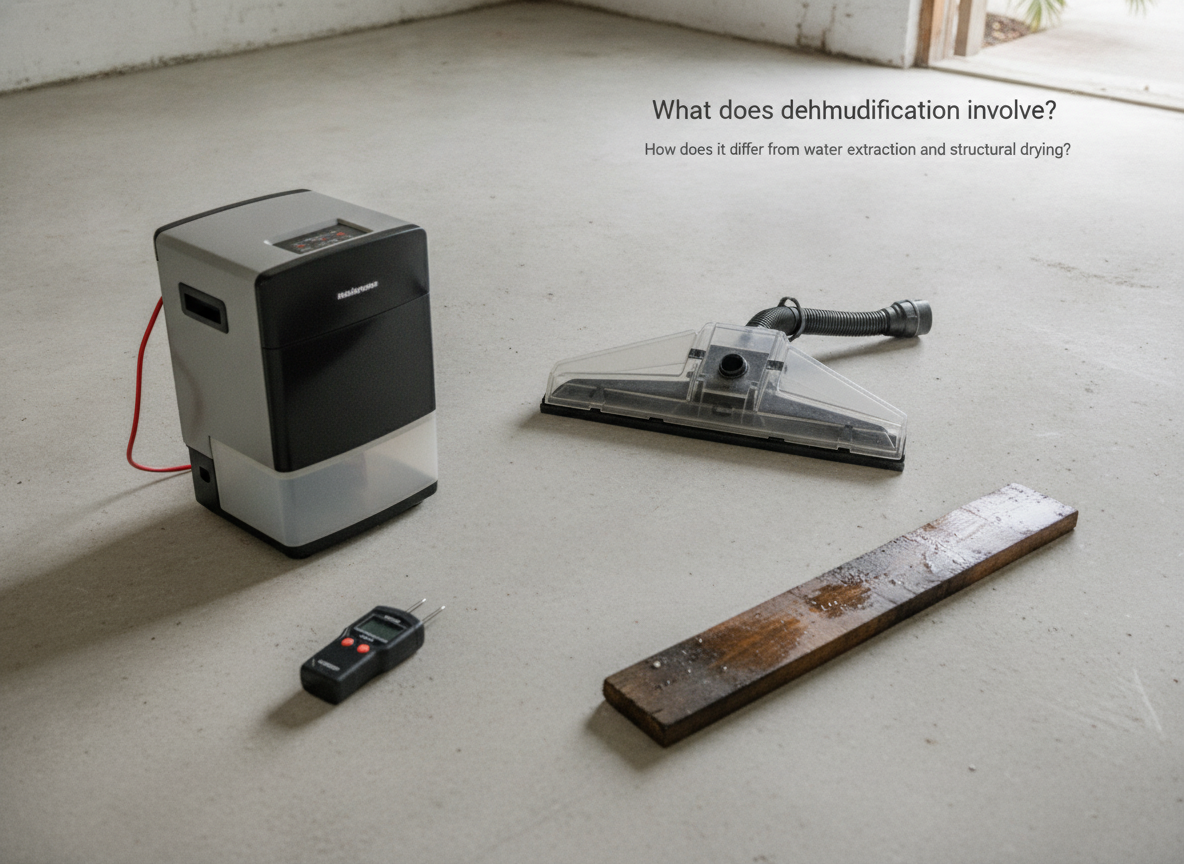
Water extraction, dehumidification and structural drying describe different parts of moisture-related work. Understanding the terms makes it easier to discuss a proposed scope without assuming that one service includes every other task.
Water extraction
This addresses water that needs to be removed, rather than describing moisture removal from the air.
Dehumidification
This focuses on reducing moisture in the air.
Moisture detection
This concerns identifying moisture, rather than removing it.
Structural drying
This focuses on drying building materials, rather than simply removing collected water.
When reviewing proposed work, ask which of these services applies and what each is intended to address. A description such as “water damage restoration” names the broader service; a more specific discussion helps you understand the individual tasks being considered.
What should you ask before dehumidification work begins?
Start by describing the situation you want help with and asking how it will be evaluated. Keep your questions tied to the affected spaces and materials, rather than trying to choose equipment yourself. You want to understand the purpose of the work, its boundaries and what you will need to do while it is underway.
A focused conversation can follow these questions:
Define the concern
Ask which moisture conditions the proposed dehumidification work is intended to address.
Clarify the scope
Ask how dehumidification relates to any proposed extraction, moisture detection or structural drying.
Discuss access
Ask what access is needed and whether you should make any preparations before work begins.
Understand the assessment
Ask how progress and the end of the drying work will be evaluated.
Review the proposal
Ask for an explanation of the work and charges before authorizing services.
These are questions for planning a service, not a substitute for a property-specific discussion. They help you leave that discussion understanding what you are authorizing and which concerns the proposed work addresses.
Does dehumidification include cleaning, repairs or mold removal?
Dehumidification describes moisture removal from the air. Cleaning and sanitizing, removal of damaged materials, repairs and reconstruction, and mold removal and remediation describe different kinds of work. Keep those terms separate when discussing what you want addressed.
SOS Restoration Of Santa Clara County offers each of those services, as well as water damage restoration and flood cleanup. If your concerns extend beyond dampness, ask about them directly. For example, questions about damaged materials or repairs deserve their own place in the service discussion rather than being folded into a general request for dehumidification.
Ask what each proposed service addresses, rather than treating “dehumidification” as a catch-all term for restoration.
How can you prepare for a useful service conversation?
Before contacting a restoration business, organize the questions you want answered. Describe where you have noticed water or dampness, what you can see, and which spaces you are concerned about. Separate your observations from your conclusions: describing a wet area is more useful than deciding in advance which service must resolve it.
You can also explain your priorities, such as understanding the proposed scope, arranging access or discussing repairs. Ask for an explanation in everyday language if terms such as extraction, structural drying and dehumidification are being used together. The goal is a clear conversation about the work, not a requirement to become a drying specialist yourself.
SOS Restoration Of Santa Clara County serves Santa Clara County, Alameda County, San Mateo County, Santa Cruz County and San Benito County. Its listed services include both moisture-related work and broader restoration services, and its hours are 24 hours a day, seven days a week.
Frequently asked questions
Is dehumidification the same as removing standing water?
No. Dehumidification addresses moisture in the air; water extraction addresses water removal. Ask how each task relates to the proposed restoration work rather than using the terms interchangeably.
What should I ask about how long dehumidification will take?
Ask for the expected schedule for your property, how progress will be assessed and how you will be told about changes. Also ask how the decision to finish the work will be made.
Does SOS Restoration Of Santa Clara County offer structural drying too?
Yes. The company lists structural drying, moisture detection, water extraction and dehumidification among its services. Ask which services are being proposed for your situation.
Can I contact the business outside regular daytime hours?
Yes. SOS Restoration Of Santa Clara County is open 24 hours a day, seven days a week.
For help with dehumidification or water damage restoration, call SOS Restoration Of Santa Clara County at 408-610-3317.
Areas we serve
- ● Santa Clara County
- ● Alameda County
- ● San Mateo County
- ● Santa Cruz County
- ● San Benito County
- ● Campbell
- ● Cupertino
- ● Gilroy
- ● Los Altos
- ● Los Altos Hills
- ● Los Gatos
- ● Milpitas
- ● Monte Sereno
- ● Morgan Hill
- ● Mountain View
- ● Palo Alto
- ● San Jose
- ● Santa Clara
- ● Saratoga
- ● Sunnyvale
- ● Alameda
- ● Albany
- ● Berkeley
- ● Dublin
- ● Emeryville
- ● Fremont
- ● Hayward
- ● Livermore
- ● Newark
- ● Oakland
- ● Piedmont
- ● Pleasanton
- ● San Leandro
- ● Union City
- ● Atherton
- ● Belmont
- ● Brisbane
- ● Burlingame
- ● Colma
- ● Daly City
- ● East Palo Alto
- ● Foster City
- ● Half Moon Bay
- ● Hillsborough
- ● Menlo Park
- ● Millbrae
- ● Pacifica
- ● Portola Valley
- ● Redwood City
- ● San Bruno
- ● San Carlos
- ● San Mateo
- ● South San Francisco
- ● Woodside
- ● Capitola
- ● Santa Cruz
- ● Scotts Valley
- ● Watsonville
- ● Hollister
- ● San Juan Bautista